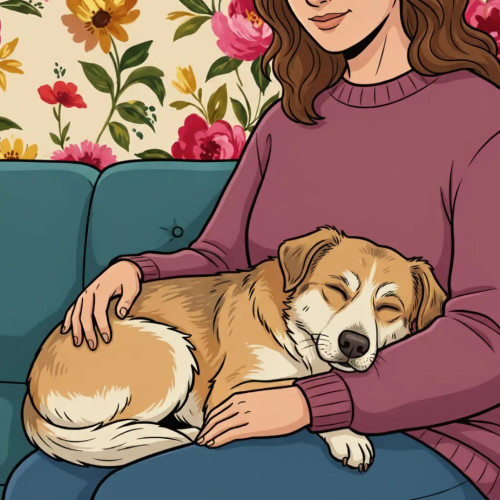
A pet does not have language for "we moved."
The pet has a body, and the body is reading every input as new. New floor, new smells, new sounds, new ceiling, new shadows on the wall at night, new unidentified dog three doors down. The body's job, in the first weeks of a transition, is to figure out which of those inputs are safe, which are routine, and which require ongoing alertness.
This is not a behavior problem. It is the body of a pet doing exactly the work it was built to do, in conditions where the work is suddenly six times harder.
New Home is a flower essence blend formulated for pets during that stretch of work. Six essences, each meeting one specific layer of what the body is doing during a transition, and the bottle is time-limited and situational by design: the situation is the gap between arrival at the new place and the pet's body deciding the place is theirs.
What "transition" actually means here
The product is built for a specific cluster of use cases. They share a structure even when the surface looks different.
A move from one house to another. A rescue's first weeks at her new home. A foster animal arriving at the doorway. A boarding stay or kennel stretch while the family travels. A barn change for a horse. A herd relocation. A long vacation with the pet in tow at an unfamiliar rental. The move itself is the easy part for the pet, in the sense that adrenaline carries her through the unloading. The harder part is the four-day, ten-day, twenty-day stretch after, when the body is supposed to start reading the new place as home, and is still asking.
This is different work from a few related problems the bottle is sometimes confused with.
It is not the everyday-departure work that Be Right Back does, where the pet is otherwise settled and the issue is the gap of being-left when you walk out the door. New Home is the larger frame of being-relocated. (See Be Right Back if it is the daily goodbye that is hard, not the new house itself.)
It is not the deep identity work Trust the Good does, where the pet is carrying a hard past as the architecture of who she is. A rescue may need both products in her first weeks: New Home for the doorway, Trust the Good for the wound. They do different jobs at different layers. (See Trust the Good if the recognition is "this is who she is now after what happened" rather than "this is the body adjusting to the move.")
The six essences
The blend is sequenced so the most directly on-point essence is at the top and the supporting layers follow. This is not arbitrary order. Sweet Pea is the central match for what a transition is asking of the body, and the other five meet adjacent layers that the central one alone cannot reach.
Sweet Pea (the belonging essence)
The animal who cannot settle into a place. The rescue dog rehomed three times. The military family's pet who has moved every two years and never fully bonds with a place. The feral cat brought indoors who paces the perimeter endlessly. The horse moved from barn to barn that never integrates with the herd. Sweet Pea helps the body develop roots and a sense of place, the felt sense of "this is where I live and these are my people." Essential after any relocation: a new house, a new barn, a new foster home. Also for animals who seem emotionally nomadic, who move from spot to spot or person to person without ever truly landing. Sweet Pea says: you belong here. You can stop searching.
Solomon's Seal (the rigidity layer)
For the animal who becomes rigid, frantic, or reactive when things do not go as expected. The dog who melts down when the walk route changes. The cat who redirects when her routine is broken. The horse who cannot recover when the pattern is disrupted. Solomon's Seal helps the animal relinquish attachment to specific outcomes and recover from disappointment quickly. During a move, almost nothing day-to-day stays the same: the food bowl is in a different corner, the morning light comes through a different window, the walk goes a different direction. Solomon's Seal is the bottle's answer to the body's resistance to all of that wrongness.
Black Currant (the survival-fear layer)
For the deeper, body-level fears: fear of new environments, fear of losing everything familiar, fear that something fundamental has been taken away. This is the dog who falls apart in the new house, the cat who panics when moved to a new home, the horse who melts down when separated from his herd at the new barn. Black Currant fears run at the survival and belonging level, and they often have generational roots, inherited through the breeding line rather than developed from this animal's own experience. Black Currant goes into that ancestral fear pattern and steadies the body's sense that the animal is still here, still themselves, still safe, even when the address has changed.
Bull Thistle (the confinement layer)
For animals with a strong reaction to confinement, restraint, or unfamiliar enclosed spaces. The horse who panics in the trailer on moving day. The dog who thrashes in a crate at the new house. The cat who flattens against the back of the carrier. Bull Thistle addresses the layer beneath these reactions, often rooted in past experience of being trapped, confined, or controlled by force. Essential during boarding stays and kennel transitions, where the animal must accept structured containment in an unfamiliar place by unfamiliar people. It helps the animal distinguish between healthy structure (a kennel run, a trailer, a crate at the new house) and the harder confinement of the past.
Japanese Knotweed (the multi-pet layer)
For animals in multi-animal households where the group dynamic has been scrambled by the move. The barn where two horses that used to share a fence line have started bickering since the relocation. The house with three cats locked in territorial standoff in the new layout. The pair of dogs who tolerated each other in the old house and cannot find each other in the new one. Japanese Knotweed helps harmonize divergent energies within a group and supports the rebuilding of the social order in a new physical space. In a multi-animal household, this layer is not optional during a transition.
Dill (the sensory layer)
For animals in sensory overload. The dog who loses all training in the new environment because there is too much new input to track. The cat who shuts down in the new layout. The bird who screams or plucks in the new room. The shelter animal surrounded by barking and slamming doors and strange smells all day. Dill helps the nervous system organize sensory information rather than treating every new sound, scent, and movement as equally urgent. It does not dull the senses. It refines them, so the animal can function in a complex new environment without being flooded.
What it is and is not
What it is: a blend of flower essences in spring water, preserved with brandy. The bottle does not contain the plants. It contains the imprint of the plants in water. The work is energetic. There is nothing in the bottle that sedates, dulls, or chemically intervenes.
What it does: supports the body of the pet through a finite stretch of adjustment work. It does not produce a "different pet." It does not flatten what the pet is feeling. It supports the layer underneath behavior, the body's settling work, so the pet's own native capacity to land in a new place has more room.
What it is not for: the everyday departure (see Be Right Back), the hard-past identity wound carried into a settled home (see Trust the Good), ongoing multi-pet household tension that is not transition-driven (see Harmony), reactive snapping or biting (see Socially Settled).
A short note from the legacy reviews
There is one native customer report on file for this blend (it has been on the catalog under different shelf positioning for a long time without much marketing push, and the review pool is thin):
Julie put the drops in her cats' water dish on the first evening of a big move. Her ten-year-old, who had hidden under the bed for two weeks each of the last three times Julie had moved, was out from under the bed by morning. The next day both cats were roaming the house "like they've always been here." The younger cat made friends with the household's other cat. The whole multi-cat dynamic landed in a window of days instead of weeks.
That is one report on a multi-cat relocation. Most settling stories are quieter, the dog laying down on the seventh night instead of the fourteenth, the cat sitting in a sunbeam two weeks earlier than at the last move. The body, gradually, begins to trust the new place.
Sister products
- Trust the Good for rescues carrying hard-past wounds at the identity layer.
- Be Right Back for the everyday departure, when you walk out the door for work.
- Harmony for ongoing multi-pet tension not driven by a move.
- Socially Settled for reactivity, snapping, biting, resource guarding.
- Stay Calm for general anxious behavior, vet visits, hypervigilance.
- Rumble Ready for storms and fireworks.
Frequently Asked Questions
What is New Home?
New Home is a flower essence blend made for pets in transition: the move, the rescue's first weeks at her new house, the foster placement, the boarding stay, the barn change. Six essences (Sweet Pea, Solomon's Seal, Black Currant, Bull Thistle, Japanese Knotweed, Dill) support the body of the pet through the stretch between arrival and the pet's body deciding the new place is theirs. It is time-limited and situational by design.
How do I give New Home to my pet?
4 drops in the water bowl, or however your pet drinks, is a good starting point. It does not matter if other animals drink out of it too. You can dose several times a day during the first weeks of the transition. The bottle is 1 oz and lasts about a month at daily use.
What if my pet won't drink the water, or I want a more direct route?
Several alternates work. Dogs will sometimes lick a few drops off a spoon, or you can shoot it directly into the mouth (rinse the dropper before putting it back if it touches the mouth). You can rub it into the skin or gums; the inside tip of the ear (not down inside the ear canal) is usually accessible. A few drops on the paws often gets licked off. If your pet eats wet food, adding drops to the food works as well.
Can I give New Home to multiple pets at once?
Yes. Adding 4 drops to a shared water bowl is one of the easiest ways to dose a multi-pet household, and other animals drinking from the same bowl is fine. For multi-pet relocations specifically, the Japanese Knotweed essence in the blend supports the household's whole social dynamic, not just one animal at a time.
How long until I see something?
Some pets respond within the first day or two; others settle gradually over the first few weeks. Most settling reports are quiet rather than dramatic: the dog laying down on the seventh night instead of the fourteenth, the cat sitting in a sunbeam two weeks earlier than expected, the horse joining the herd circle in week three instead of week six. The bottle supports the body's settling work; the timeline depends on the pet and the size of the transition.
My pet is a recent rescue. Should I use New Home or Trust the Good?
Often both. New Home is for the transition layer: the doorway, the unfamiliar smells, the first weeks of the new household. Trust the Good is for the deeper identity layer: the hard past the rescue is carrying as the shape of who she is now. A rescue in her first weeks home may need New Home for the doorway and Trust the Good for the wound. They do different jobs at different layers and can be used side by side.
My pet is settled in the house but falls apart when I leave for work. Is New Home the right product?
Probably not. That pattern (the everyday goodbye, the gap of being-left when you walk out the door of a place the pet otherwise reads as home) is what Be Right Back is built for. New Home is for the larger frame of being-relocated, not the daily departure. If both apply (a recent move plus daily-departure distress), the two products can be used in sequence: New Home through the first weeks, Be Right Back once the new place is the place.
Is New Home safe alongside medications or other supplements?
Flower essences are energetic and do not interact chemically with medications or supplements. We do recommend taking no more than one essence blend at a time so each blend's pattern can land clearly. Always consult your veterinarian about your pet's overall care plan, especially if your pet is on prescription medications.
Where's the science behind this?
The full mechanism explanation, the research base for the bioessences, and the way the frequencies and flower essences are designed to work together lives on our Science Hub page. That page covers what bioessences are, how they differ from herbal supplements, the role of vibrational imprints in spring water, and what the underlying research looks like. If you want the deeper dive before or after trying this bottle, that is the page to read.
These statements have not been evaluated by the FDA. This product is not intended to diagnose, treat, cure, or prevent any disease. You should not rely on this information as a substitute for, nor does it replace, professional medical advice, diagnosis, or treatment. Always consult your veterinarian before beginning any new wellness program for your pet.