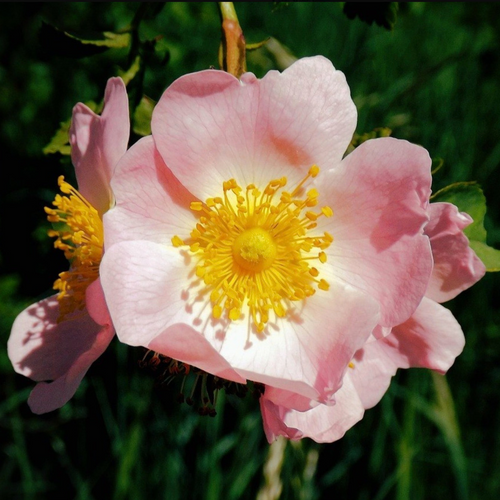
Wild Oat Flower Essence
For the person who could do anything... and can't figure out which thing to actually do
You Have More Potential Than You Know What To Do With
And that's exactly the problem.
You're talented. You know that. Other people know that too—they've probably told you many times that you could succeed at anything you put your mind to.
The trouble is, you've put your mind to a lot of things.
And nothing has quite... stuck.
Not because you failed. You probably didn't fail. You probably did reasonably well at most of the things you tried. Maybe even very well.
But something was always missing.
That feeling of yes, this is it. That sense of clicking into place. That knowing—deep in your bones—that you've found what you're supposed to be doing with your one wild and precious life.
Instead, there's this restless hum. This nagging sense that you haven't found your thing yet. That you're still sowing wild oats when you should have settled into a harvest by now.
The Curse of Being Good at Many Things
Here's what nobody tells the multi-talented:
Having options is supposed to be a blessing. Being capable of doing many things well is supposed to be an advantage.
But when you can do anything, how do you choose what to do?
When every path seems viable, how do you pick one?
When you're talented enough to succeed at multiple careers, how do you commit to just one?
The paradox of potential: the more you have, the harder it can be to direct.
You've probably noticed this pattern:
You start something new with enthusiasm. It goes well. Then another opportunity appears—equally interesting, equally viable. You wonder if maybe that path would be better. More fulfilling. More aligned with who you really are.
So you try that too.
And it goes well.
And then...
The cycle repeats.
Not because you're flaky or unfocused or commitment-phobic. But because you genuinely don't know which path is yours. Which calling is the calling. Which of your many seeds should become your one great harvest.
"Sowing Wild Oats"—The Phrase That Says Everything
There's a reason this expression has survived for nearly 500 years. The name "Wild Oat" isn't accidental. This essence was created for exactly the person who's still sowing wild oats when they're ready to cultivate a real harvest.
"Sowing wild oats" dates back to at least 1542. It describes that period of life when you're exploring, experimenting, trying different things before settling down.
It's considered a normal, even necessary phase. The wandering years. The figuring-it-out time.
But here's what the phrase also implies: eventually, you're supposed to stop.
Eventually, you're supposed to find your thing and commit to it.
The wild oats were never meant to be the final crop. They were meant to precede the real harvest.
If you're reading this, you may have been in the wild oat phase longer than feels comfortable. Maybe decades longer. And part of you is wondering when—or if—you'll ever feel that clarity of direction everyone else seems to have found.
What Dr. Bach Understood
Dr. Edward Bach, the physician who developed the original 38 flower essences in the 1930s, identified Wild Oat as one of the most fundamental remedies in his entire system.
He created it specifically for:
"Those who have ambitions to do something of prominence in life, who wish to have much experience, and to enjoy all that which is possible for them, to take life to the full. Their difficulty is to determine what occupation to follow; as although their ambitions are strong, they have no calling which appeals to them above all others."
Read that again.
"Their ambitions are strong."
"They have no calling which appeals to them above all others."
This isn't about lacking drive. It's about lacking direction for the drive you have.
This isn't about being unmotivated. It's about being motivated toward too many things to choose clearly.
Bach considered Wild Oat so important that he designated it one of only two "polycrest" remedies—fundamental essences that address core human challenges. For Bach, the question "What am I here to do?" was one of the most essential questions a person could face.
The Wild Oat Plant Signature
Look at the plant itself and you'll understand the pattern.
Wild oat (Bromus ramosus) is a grass. It grows tall—reaching toward the sky with clear aspiration. It looks almost identical to cultivated oats, the kind farmers grow for harvest.
Almost identical. But not quite.
Wild oats don't produce useful grain. They look productive. They look like they should yield something valuable. But at harvest time, there's nothing there to gather.
For farmers throughout history, wild oats have been a curse. They're nearly impossible to tell apart from cultivated oats until it's too late. They steal resources from the real crop. They multiply year after year, spreading their useless potential through the field.
The signature couldn't be clearer: undirected potential yields nothing.
It's not about lacking ability. Wild oats have all the biological equipment to produce grain. They just don't—because they've never been cultivated, focused, directed.
The difference between wild oats and cultivated oats isn't capability. It's commitment. Focus. Direction.
What Wild Oat Flower Essence Supports
Wild Oat flower essence supports clarity about your life's true direction.
It doesn't give you a new calling. It supports your ability to recognize the one you already have.
Think of it like this: the signal is already being broadcast. Wild Oat helps you tune your receiver.
This essence supports:
Connecting to your inner compass. That sense of direction that tells you this path—not that one—is yours. The gut knowing that's been buried under too many options.
Clarity amid options. When everything seems equally viable, Wild Oat supports the ability to feel the difference between "could do" and "should do."
Vocational certainty. The word "vocation" comes from the Latin for "calling." Wild Oat supports hearing that call above all the noise.
Commitment without regret. Once you see your path clearly, Wild Oat supports walking it without constantly wondering if you chose wrong.
Work as expression. Instead of working just to survive, Wild Oat supports finding work that expresses who you actually are.
Who This Essence Is For
The person with many talents but no clear direction. You could succeed at several different things. That's your blessing and your curse. The most talented people often have the hardest time finding direction. Not because something is wrong with them, but because so much is right. Having multiple gifts is wonderful—once you know which one to develop. Wild Oat supports that knowing.
The chronic restarter. You've launched many things. Tried many careers. Explored many interests. Each one went reasonably well, but none felt like home. You're ready to stop starting over.
The "what should I do with my life" questioner. You've asked this question more times than you can count. You've read the books. Taken the assessments. Had the conversations. And you still don't have an answer.
The mid-life wanderer. You're not young anymore, and you still haven't found your thing. The urgency is real. So is the frustration. You need clarity, and you need it now.
The dissatisfied achiever. You've accomplished plenty. By external measures, you're successful. But internally, something is missing. You've achieved, but you haven't arrived.
The talented generalist. Jack of all trades, master of none—and quietly wondering if you should have mastered one. You're ready to stop spreading yourself thin and go deep somewhere.
The Negative State Wild Oat Addresses
In the Wild Oat negative state, you might experience:
Chronic dissatisfaction with work. Nothing quite fits. Every job has something wrong with it. Every career path eventually disappoints.
Restless drifting. Moving from thing to thing without ever landing. Always wondering if the next path will be the right one.
Delay and frustration. Life keeps not starting. You keep waiting to find your thing before you fully commit. And the years keep passing.
Working for survival, not meaning. Taking jobs because you need money, not because they express who you are. Surviving rather than thriving.
Fear of commitment. Because what if you commit to the wrong thing? What if you lock yourself into a path and then discover it wasn't the right one?
Envy of people who "just know." They seem so certain. So clear. So settled. And you're still spinning.
The Positive Transformation
In the Wild Oat positive state:
You know your calling. Not because someone told you. Not because an assessment revealed it. Because you feel it—clearly, certainly, unmistakably.
Work becomes expression. Your career isn't just a way to pay bills. It's a way to express who you are. Your gifts have a channel.
Commitment feels natural. Because you're no longer choosing between equal options. You're recognizing the one that was always yours.
Restlessness resolves. Not into resignation, but into direction. The seeking energy finds its object.
Potential becomes harvest. Your wild oats get cultivated. Your scattered seeds grow into a real crop. You produce something of value—because you finally know where to plant yourself.
Two Paths Forward
You can continue as you have been.
Exploring. Trying. Starting over. Moving from option to option, waiting for the right one to announce itself.
That might work. Eventually. Maybe.
Or you can support the process.
You can work with an essence specifically formulated for the exact pattern you're experiencing—strong ambition, multiple talents, no clear direction.
Wild Oat has been helping people find their calling for over 90 years. It's one of Dr. Bach's original 38 remedies, time-tested and widely respected.
Maybe your calling is already clear to some part of you. Maybe you just need help hearing it above all the noise.
These statements have not been evaluated by the Food and Drug Administration. This product is not intended to diagnose, treat, cure, or prevent any disease. Flower essences are a form of energetic support and work on subtle levels; they are not a substitute for medical care.
This is a 1 fl oz stock strength bottle.
All of our essences use brandy as a preservative. For more information regarding the brandy as well as alternatives, click here.